
We Caved on Everything
The April 7th Plan Commission heard two appeals originating from the Historic Preservation Committee.

A fairly blunt admission, don’t you think? The April meeting of the Plan Commission was the rare instance where our only business were appeals of decisions from the Historic Preservation Commission. Our regular business – zoning, permitting, housing, and development – was away on holiday.
After the meeting, as we rose from our seats in Council Chambers, several of us confessed, myself included, that we had fully intended to uphold the HPC rulings. And even now, I feel we let the Historic Preservation Committee down, as well as all the historic homeowners who have complied with the rules.
The first matter involved a homeowner in the 100 block of South First Street. His home sits in one of our historic districts. Some district homes are among the City’s more affordable. At the same time, the rules protecting historic homes make them significantly more expensive to maintain. It’s not uncommon that a family, having purchased a home they can afford, find maintaining it a heavy financial burden.
The subject house at 122 S. First St, had significant damage from hail last year. Even prior to the storm, the old-growth wood siding was deteriorating, a combination that left the exterior in very rough shape.
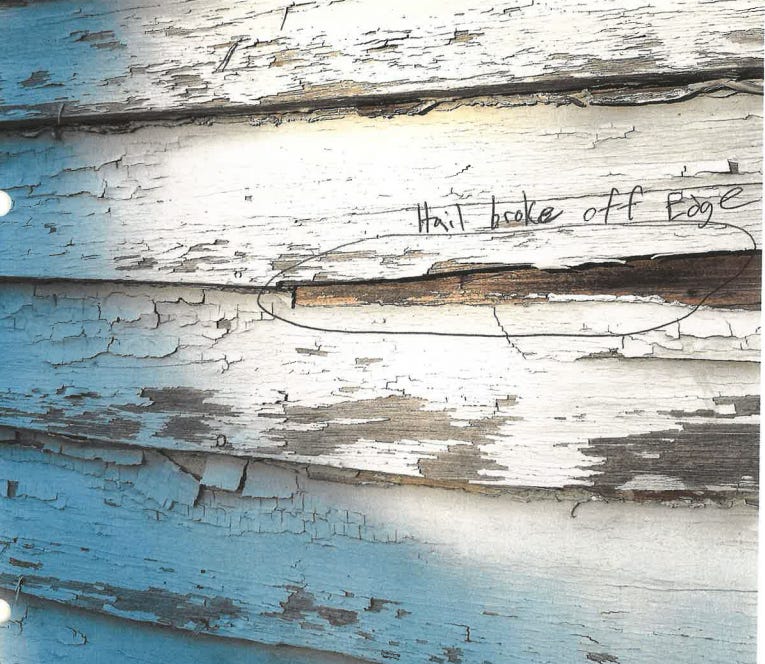
The matter was further complicated by an automobile collision — yes with the house. The resulting damage required complete removal of some original siding and structure. For the repairs, the homeowner requested the HPC (Historic Preservation Commission) approve vinyl siding.
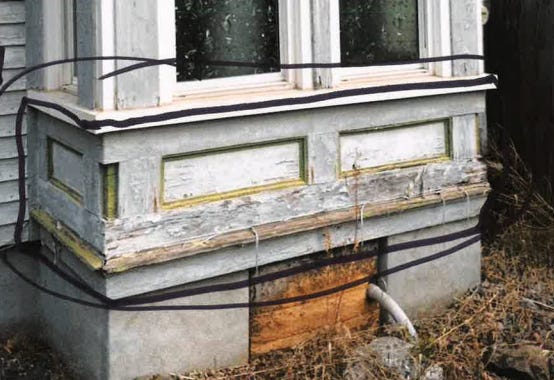
Surprising to me, HPC did approve vinyl siding - though they specified smooth shiplap vinyl. But to mitigate that concession on material, they asked the homeowner to retain and repair a section of ornate molding under a bay window. The homeowner disagreed with the ruling and appealed the decision with HPC. The original HPC decision was 5-1. On appeal it was unanimous – the homeowner needed to retain the historic molding.
The homeowner continued the fight, appealing to the Plan Commission — our April 7th meeting. At the outset, Community Development Director Colette Spranger admitted she had never dealt with an appeal from Historic Preservation, and this would be a new experience for us all.
Richard McGaw, the homeowner, provided photos of the home in its current condition. The property appeared to be suffering from neglect, regardless of the hailstorm. A term in the historic preservation community, “demolition by neglect,” might apply, in which a building is allowed to deteriorate to the point that restoration becomes unreasonable.
Mr. McGaw laid out a series of arguments on why the HPC ruling should be thrown out. He based his arguments on affordability, consistency, and preservation.
On the basis of affordability, the homeowner shared that insurance from the hailstorm covered residing the house, but not the maintenance of the historic features. Prior to the meeting, I sought guidance from someone closer to historic preservation issues. Their recommendation was to review the claim adjuster’s report. We did not do that, and that was probably a mistake.
With regards to consistency, Mr. McGaw pointed out that all his neighbors, also in the historic district, had been allowed to reside with vinyl. Ms. Spranger explained that HPC has gotten more strict in recent years, but their rigor has varied over the span of time. I was pained by the inconsistency in this neighborhood, and that weighed on my decision.
Lastly, Mr. McGaw pointed out that the new siding would cover the existing exterior, not replace it. I asked if this included the historical ornate molding, and he indicated yes. The vinyl would protect the siding from further exposure and might — in fact — be the best way to preserve it for some future owners.
Mayor Duggan, chair of the Plan Commission, asked for a motion. There was none. She then offered it herself, to overturn the ruling of Historic Preservation and allow Mr. McGaw to move forward residing the entire exterior. Ms. Barnes provided the second. I voted in favor of overturning the HPC ruling as did 3 of my peers. The vote was 4-1, Mr. Gishnock was opposed.
At the time I felt it was the right — if flawed — decision. In retrospect, I have some doubts, particularly after Mr. McGaw took to social media encouraging others to push back against HPC rulings. I would encourage all to ignore his advice. I think we would offer much greater resistance in any future appeals.
Municipal Court Judge Tom Alisankus was at the meeting to witness our process of handling the appeal. The next day, I asked him for his feedback. Here is part of his reply:
Little if any deference was given to the Historic Preservation Commission. Essentially, the process seems to allow for just a different set of eyes looking at the same issue with the authority to substitute its opinion for that of the Historic Preservation Commission. And without really explaining why.
I’m assuming the H. Commission put some amount of time into gathering information about the neighborhood and the relevant ordinances, and the history and the specific facts of each case, and made their decision based on all of that. What you don’t want to happen is for the H. Commission to say, ‘why bother, the Planning Commission can just overrule us anyway.’
I pointed out what seems an inherent conflict between the goals of the HPC versus the Plan Commission, and asked whether another body — perhaps even the Municipal Court — would serve as a better setting where these appeals are heard.
After some research, Judge Alisankus replied that while there is precedent for a Municipal Court to hear such appeals, it then creates a conflict of interest should the matter later go to trial - as in the case for a non-payment of fines and penalties. He recommended we create a better defined process and continue to hear these appeals in the Plan Commission.
In the appeal we heard, we had a defendant. We did not have any clear voice representing the Historic Preservation Commission, other than Ms. Spranger, who was also trying to administrate the proceedings. In normal business, Colette would try to remain neutral and not unduly interject her opinion on the discussion. Here, we needed an impassioned advocate for the HPC ruling.
Based upon my conversations with the Judge, creating a formal hearing process where people are sworn in, where we have the right to collect and review evidence, and then proceed to a finding seems like it could yield a fairer outcome.
Beyond this specific appeal and the issues it revealed – I do think we need to have a reckoning in the conflict between historic preservation and affordability. Many of our historic homes have aged to the point that the siding is deteriorating - even where reasonably well maintained. It pains me to watch building owners paint and repaint every few years – I’m sure at considerable cost. Personally, affordable housing is much closer to my ongoing concerns and I am sympathetic with the costs and work required to maintain historic properties. While I don’t see an easy compromise, the topic may be worth considering for our next Committee of the Whole.
In the meantime, a door opened at the following afternoon’s Finance Committee meeting which may provide some resources for those financially struggling to maintain historic homes. I’ll share that in an upcoming report — as well as the other matter we heard on appeal at the April 7th Plan Commission Meeting. More to come.
Stay well
Bill
I think that the historic district is important and helpful in many ways to keep our town and the majestic homes preserved as best as possible. However, as a compromise, I do think since it is so costly to keep these old beautiful buildings as originally sound as possible it is very, very expensive. If the historic committee could research and offer alternative replacement ways other than "original" to keep the look of original or historic. This could be an compromise or solution to many dilapidated or these meetings. Example: cement board I believe it's called, looks like real wood siding but much cheaper. Better than vinyl or aluminum. Give them contractor names who are interested in preservation without the cost. Windows, siding etc. It isn't that homeowners don't want to comply as much as they can't afford to comply sometimes. They need alternatives instead of a hard no. Just my opinion.
My questions for many towns that have historic districts - why do we still have a historic district? It appears current and future generations don’t have the “feels” for history. Do we select a smaller area to maintain the history? Or get rid of it all together? If we want to keep it then we need to set rules that are known to the purchaser and what that may take prior to purchase and have them sign an agreement prior to purchase.
I know there have been some large restoration projects done by some people and changing the rules now would cause an issue, but it’s done often as a going forward thing.